
Last updated September 20, 2026
Full 25-point door and opener safety check with every visit - springs, cables, rollers, tracks, and your LiftMaster or Chamberlain opener included
You get a price before we start. It does not change when the truck arrives.
 Before
 After
After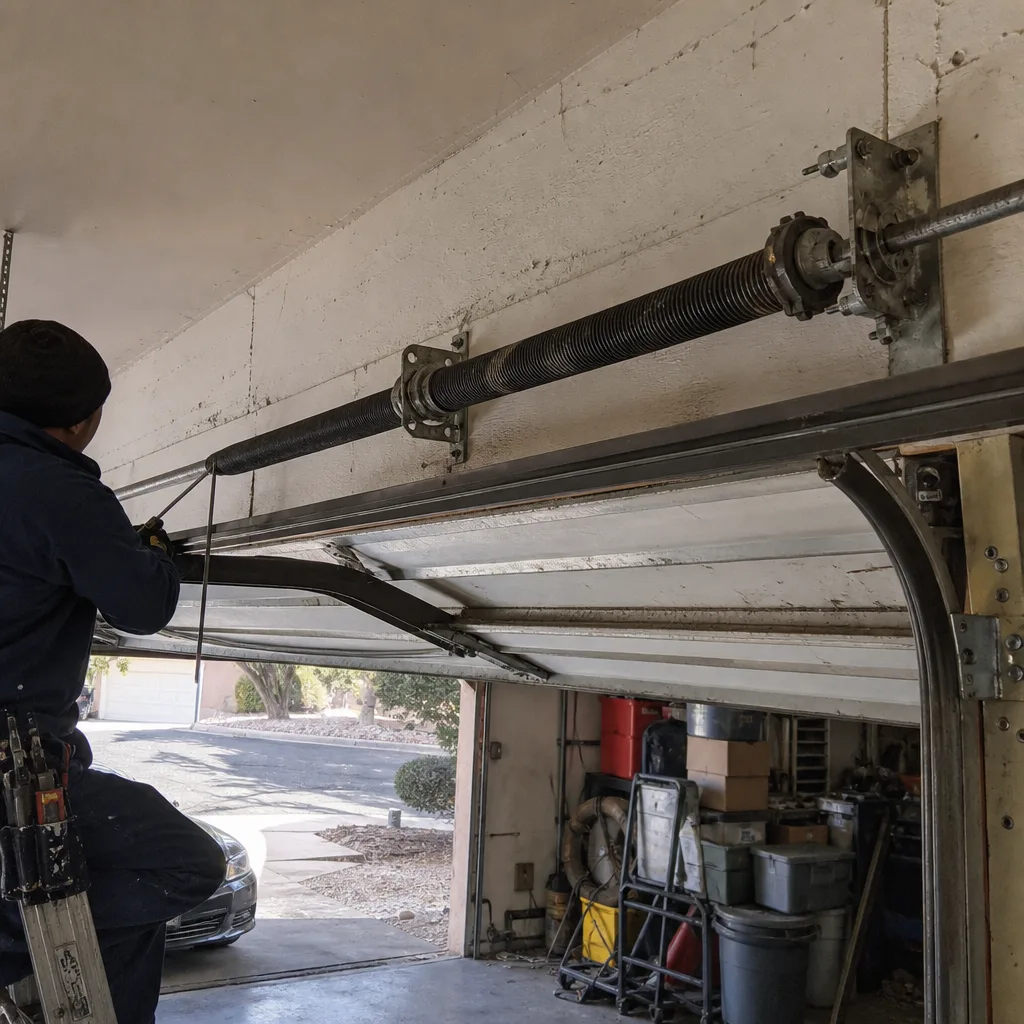 Before
 After
After Before
 After
AfterGarage Door Warning Signs: A Surprise Homeowner’s Reference Guide
Most garage door warning sign guides tell you what’s happening but not what’s responsible for it. A slow door in Surprise could be a heat-fatigued torsion spring, a stripped motor drive gear, or roller bearings dragging against dry tracks. Each has a different repair cost, a different urgency level, and a different conversation you should have with whoever shows up to fix it. This guide maps the symptom to the component, so you can name the part before the technician names a price. We’re writing this as the company that built its reputation in Surprise on showing homeowners the failed part before quoting a replacement.
Quick Answer
The seven most common garage door warning signs in Surprise are slow movement, jerky movement, loud operation, a gap at the bottom, a door that reverses before closing, remote range loss, and visible cable slack. Each symptom points to a specific component or components, and each has a different cost range and urgency level. Two of these signs, visible cable slack and a door that reverses unexpectedly downward, mean stop using the door immediately and call a professional. The rest can usually wait for a scheduled appointment, though none should be ignored for more than a few weeks.
Table of Contents
- Symptom to Component: The Seven Warning Signs Surprise Homeowners Report Most
- The Visual Inspection You Can Safely Perform Before Calling
- Two Warning Signs That Mean Stop Using the Door Now
- How to Photograph and Describe a Warning Sign for an Accurate Preliminary Quote
- Warning Signs That Are Installer Error, Not Component Wear
- Why the Surprise Climate Accelerates Certain Warning Signs
- What Warning Sign Repairs Typically Cost in Surprise
- Common Mistakes to Avoid
- When to Call a Professional
- Frequently Asked Questions
BeforeAfterSymptom to Component: The Seven Warning Signs Surprise Homeowners Report Most
When a Surprise homeowner says “the door is slow,” three different components could be responsible: a worn motor drive gear, a spring set losing tension from heat fatigue, or roller bearings that have dried out and are dragging against the track. Each has a different repair cost and urgency level. The symptom is the same; the diagnosis is not. Here’s the mapping that lets you talk about your door the way a technician would.
1. Slow Movement
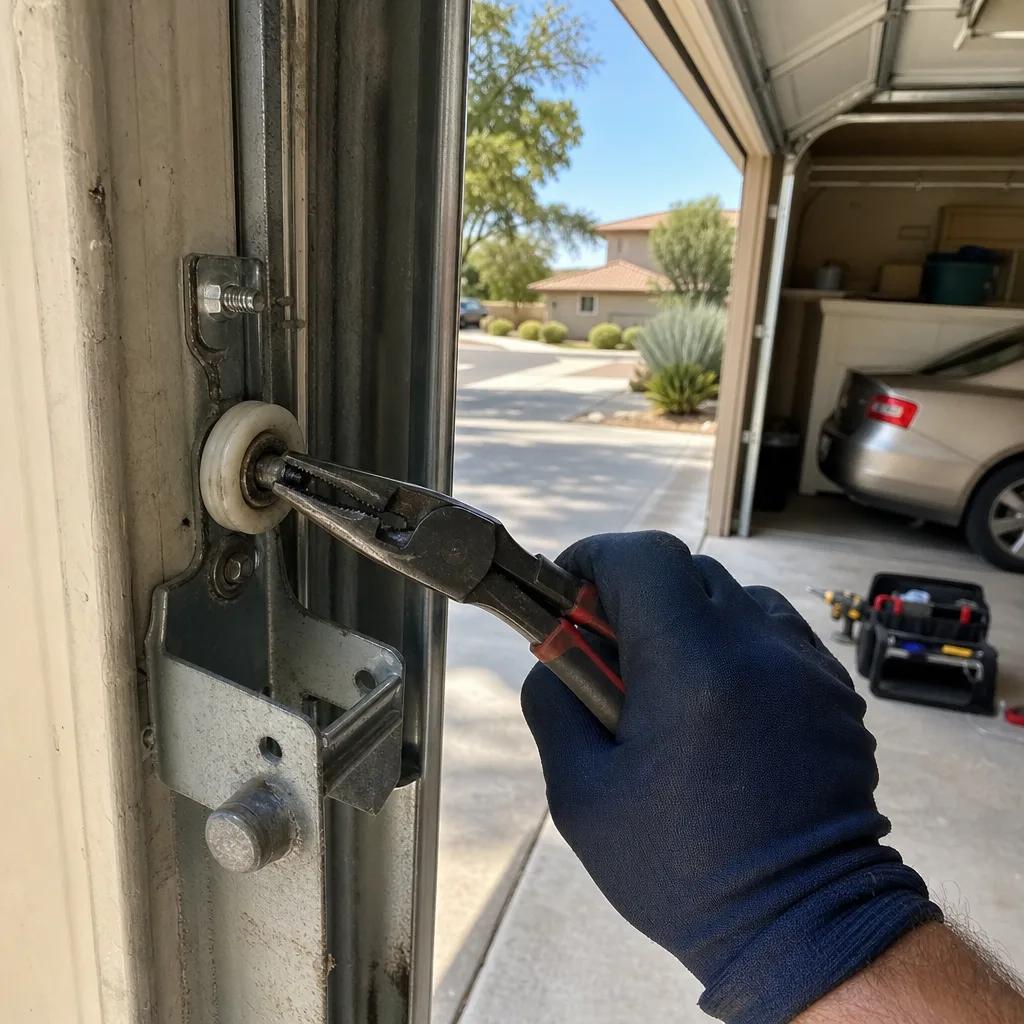
A door that takes noticeably longer to open or close than it did six months ago is usually pointing at one of three things. The motor drive gear inside the opener, a plastic gear that transfers motor rotation to the chain or belt, wears down over time and loses its bite. A torsion spring that has lost tension from Surprise’s summer heat cycles will force the motor to work harder to lift the same weight. Or the rollers, the small wheels that ride inside the vertical and horizontal tracks, have bearings that have dried out and begun to drag instead of roll. The fastest way to narrow it down: disconnect the opener with the red release handle when the door is closed, then lift the door manually. If it’s heavy or hard to lift, the problem is the spring, not the motor. If it opens easily by hand, the problem is likely the opener or a rolling component.
2. Jerky Movement
Jerky movement, the door stuttering or catching as it travels, is almost always the rollers or the tracks. Rollers that have flat spots, chipped wheels, or seized bearings will catch at the same spot in the travel arc every time because the same part of the wheel contacts the track at the same point. A bent or misaligned track section will produce the same symptom but at a variable point, depending on how the door flexes against it. Jerky motion on a door still under spring tension is a repair that belongs on the schedule soon because catching and releasing puts uneven load on everything, including the springs and the opener motor.
3. Loud Operation
Loud here means a sound that’s new, not the baseline hum of a door that’s always made some noise. A grinding sound is usually metal on metal: a roller bearing that’s failed completely or a hinge pin that’s worn through. A popping or snapping sound during the travel arc points to the torsion spring, specifically to a coil that’s binding against itself or against the spring anchor bracket. A rattling sound that seems to come from everywhere is often loose track bolts or hinge hardware that’s vibrated loose over years of daily cycles. Loud is a symptom with a source, and the source needs to be located before any repair is quoted.
4. Gap at the Bottom
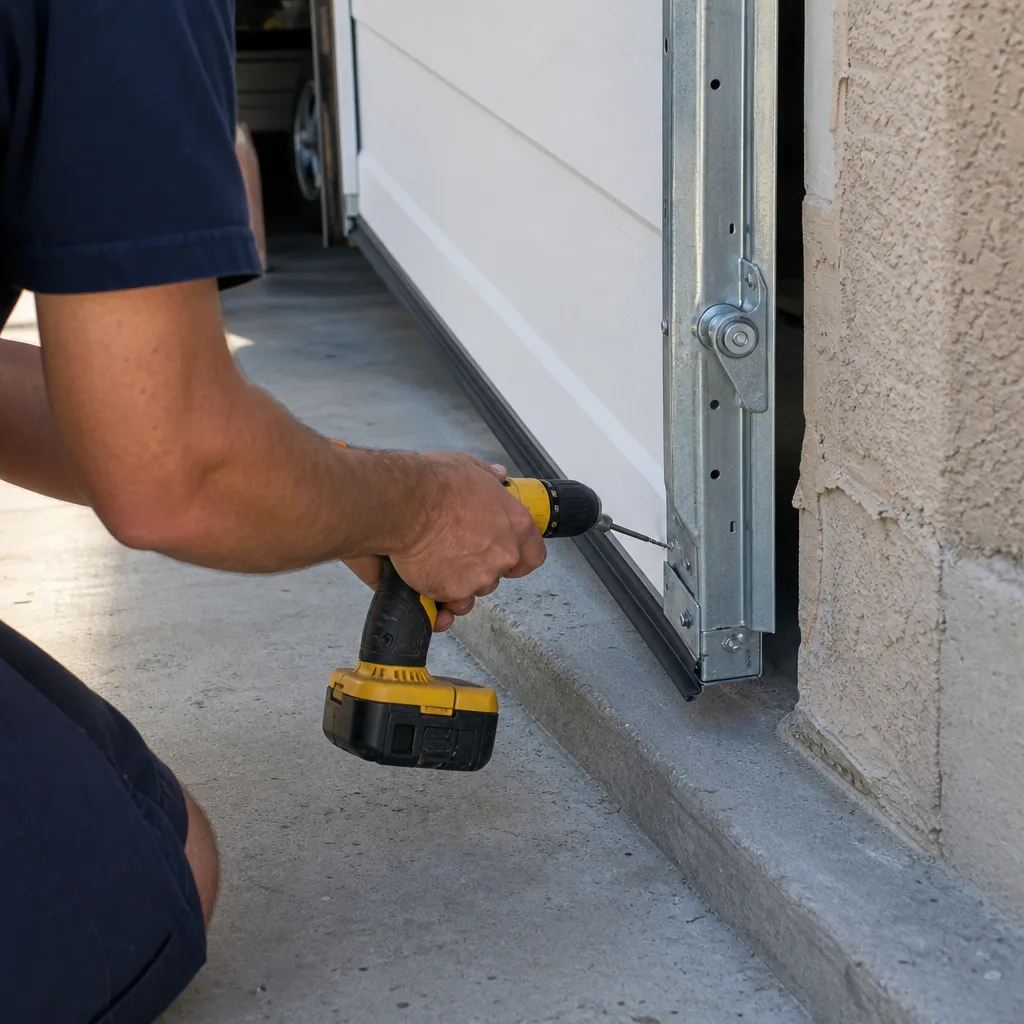
A visible gap between the bottom of the door and the garage floor, one that wasn’t there when the door was installed, usually means the door’s travel limits are set incorrectly or the bottom seal has compressed and hardened. The bottom seal, a vinyl or rubber strip that runs along the bottom panel, loses flexibility in Surprise’s heat and no longer compresses to fill the uneven spots in the slab. A gap that only appears on one side points to the travel limit switch on the opener, telling the door to stop before it reaches full down position. A gap is less urgent than a cable or spring problem, but it matters more than people think: it’s the entry point for rodents, dust, and in monsoon season, the water that pools against the slab.
5. Door Reverses Before Closing
A door that starts down, then reverses back up before touching the floor, is usually tripping the auto-reverse mechanism, the safety feature that stops the door from closing on something. The photo-eye sensors at the bottom of the door opening can get misaligned, dirty, or blocked. The close-force setting on the opener, which controls how much pressure the motor applies before the auto-reverse triggers, can be set too low, so the door interprets normal floor contact as an obstruction. The difference matters: a dirty sensor is a five-minute cleaning, a force setting that’s drifted is a 15-minute adjustment. A door that reverses because the spring is failing and the motor is hitting its force limit is a different conversation entirely.
6. Remote Range Loss
When your remote only works from 15 feet away instead of 50, the most common cause in Surprise is not the remote battery. LED bulbs installed in or near the opener emit radio frequency interference that can swamp the opener’s receiver. The fix is replacing the LED bulb with a garage-door-rated bulb, the kind specifically shielded against RF interference, and the symptom disappears immediately. Other causes include a failing logic board, the circuit board that receives the wireless signal, and a remote battery that’s genuinely low. Range loss is rarely urgent but it’s annoying enough that most Surprise homeowners call us about it within a week or two of noticing it.
7. Visible Cable Slack
There should never be visible slack in the lift cables, the braided steel cables that run from the bottom of the door, around the drum at the top of the shaft, and connect to the torsion spring system. Slack means one of two things: the spring has broken or is losing tension, and is no longer counterbalancing the door, or the cable has slipped off the drum and is no longer doing its job. Either way, the door is unsafe to operate. This is a stop-using-the-door-now condition, not a schedule-it-soon one. We’ve included the details in the section below.
The Visual Inspection You Can Safely Perform Before Calling
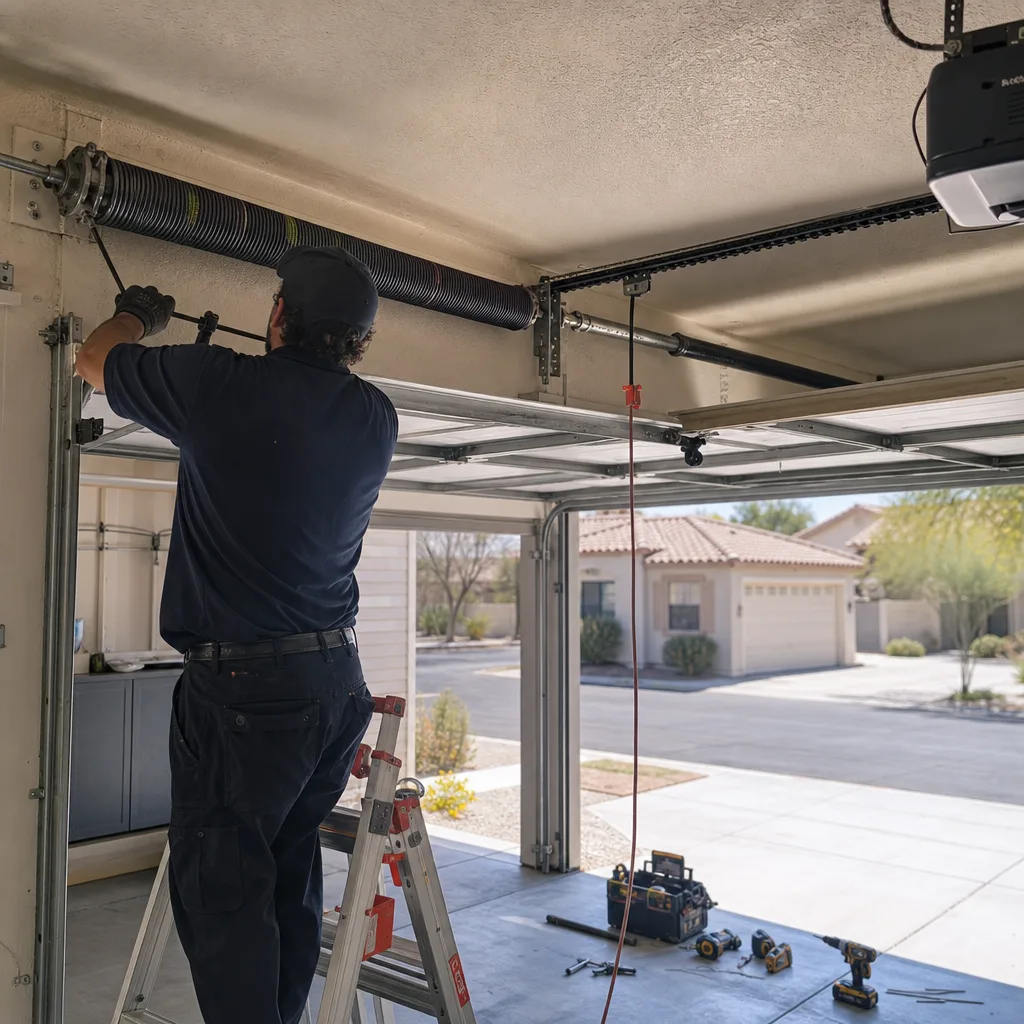
You don’t need to touch anything to learn a lot. A visual inspection with the door closed takes five minutes and gives you information that will make your phone call more productive. Here’s what to look for and what it means. If you’d rather not do this yourself, our Garage Door Repair in Surprise service includes this inspection as part of every diagnostic visit.
- Look at the lift cables. The cables should be tight against the drums, the circular spools at the top of the door opening. Loose, frayed, or kinked cable strands are visible without touching anything. A cable with a single broken strand is still under tension and still dangerous, so do not touch it, do not pluck it, do not try to re-seat it. Just note it.
- Look at the rollers. The rollers on the bottom panel and the top panel see the most wear. A roller that’s cracked, chipped, or missing material from the wheel is visible if you get on a ladder or a step stool and look at the bottom panel’s rollers with a flashlight. The roller stem, the metal shaft that goes from the wheel into the hinge, should be straight, not bent.
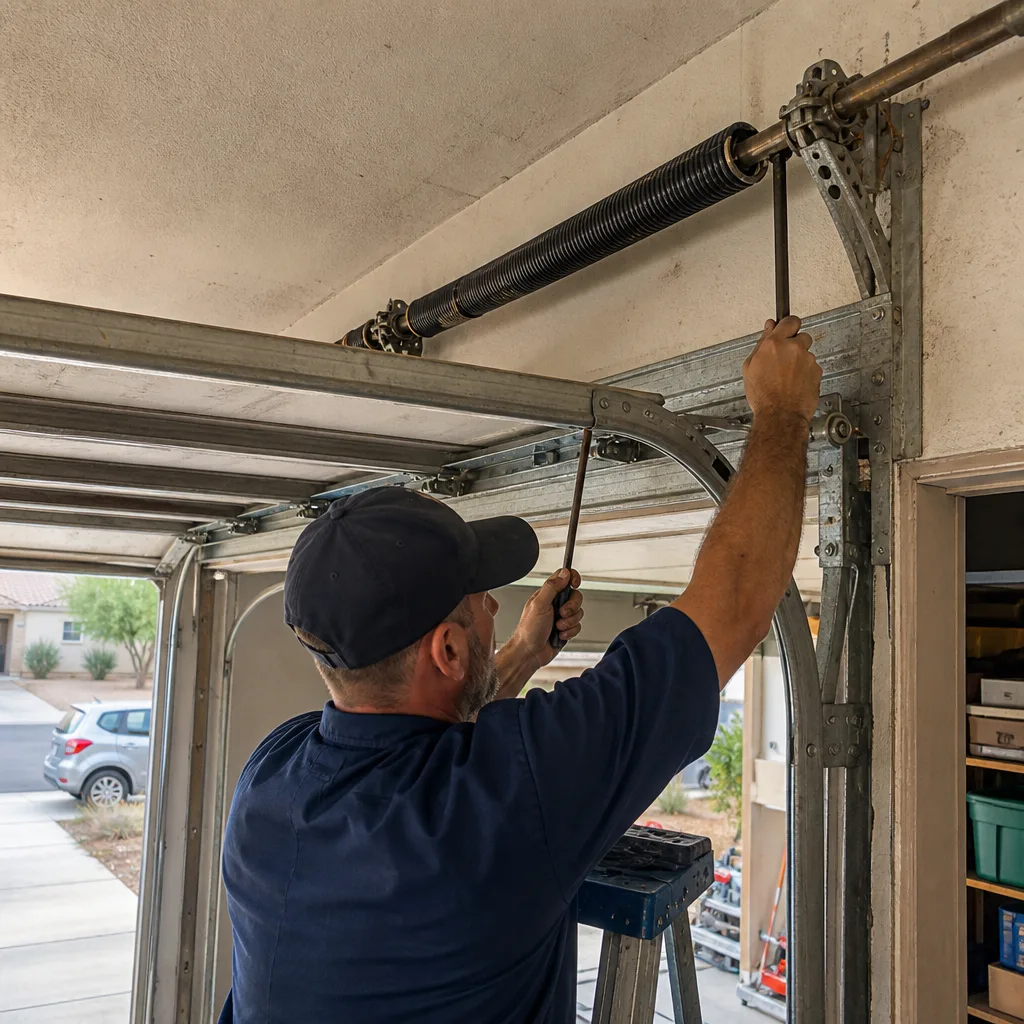
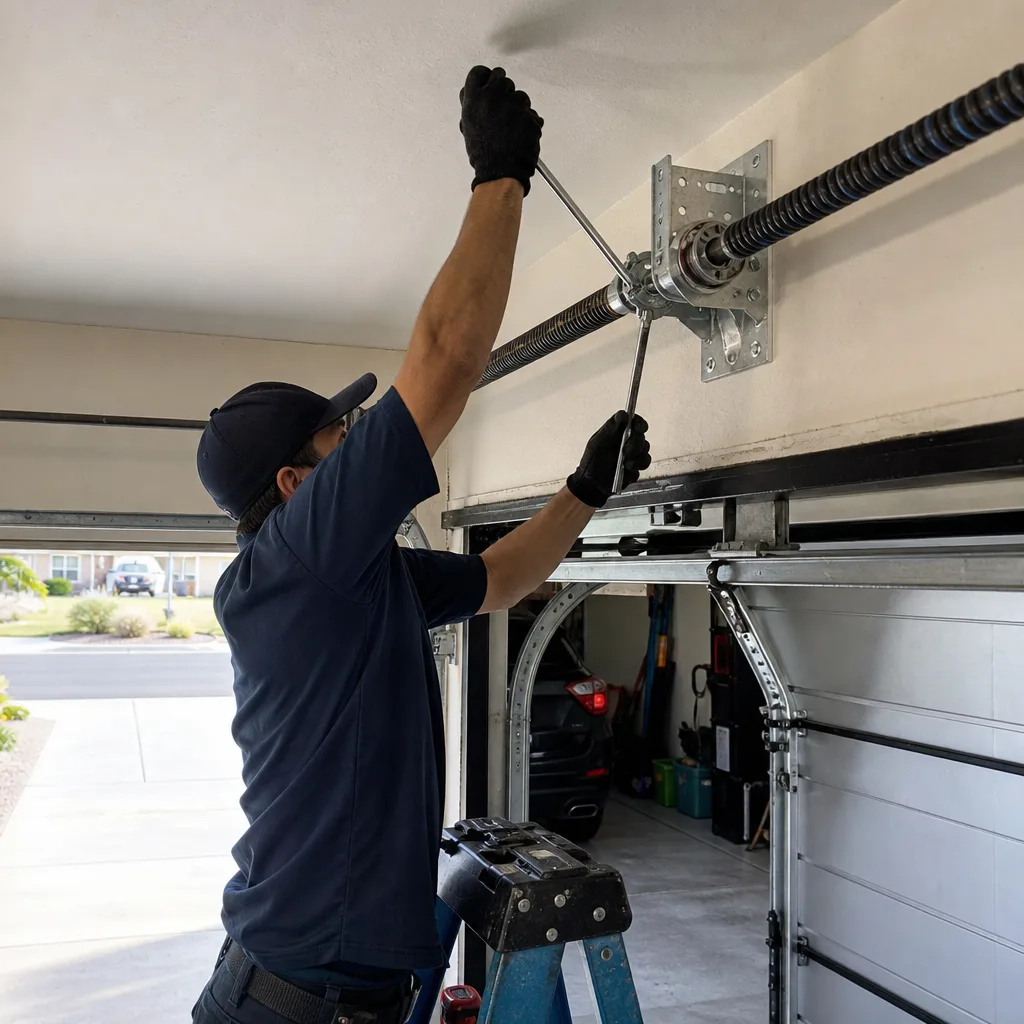
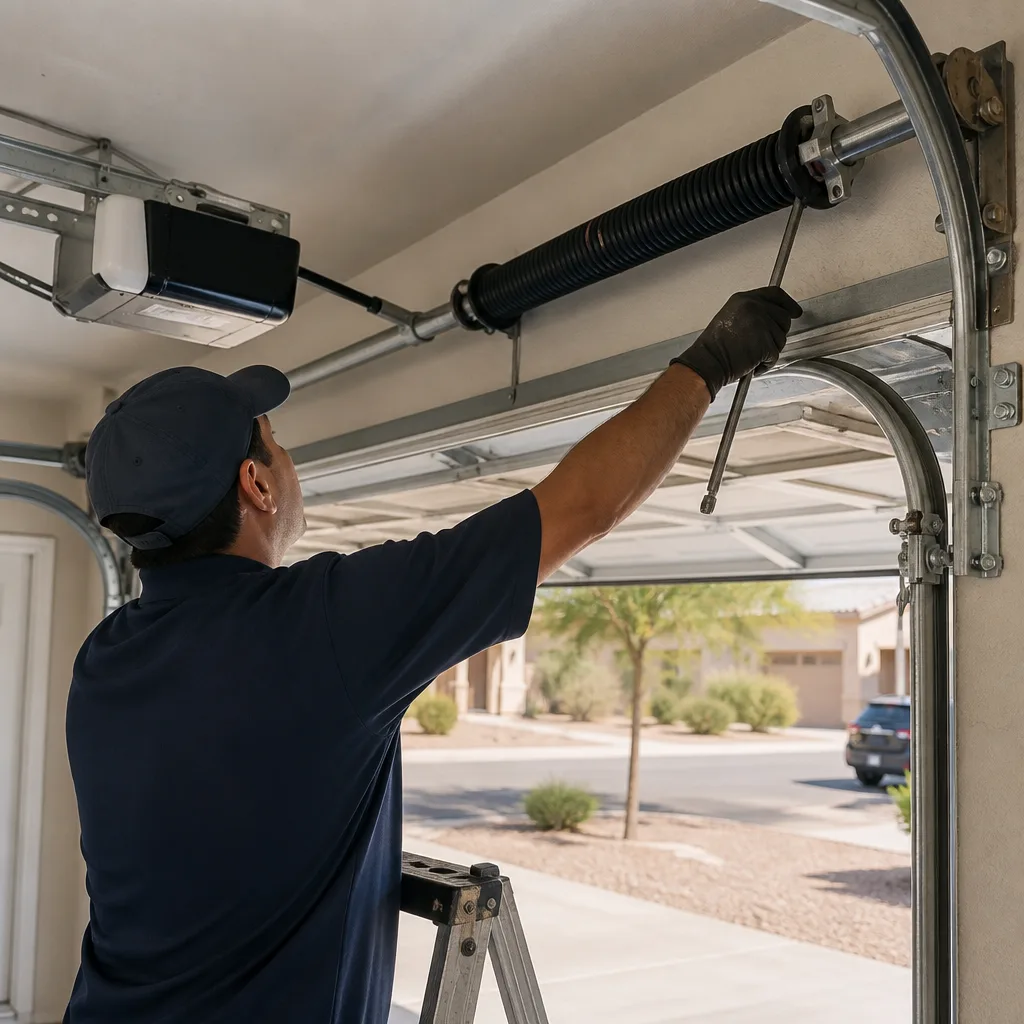
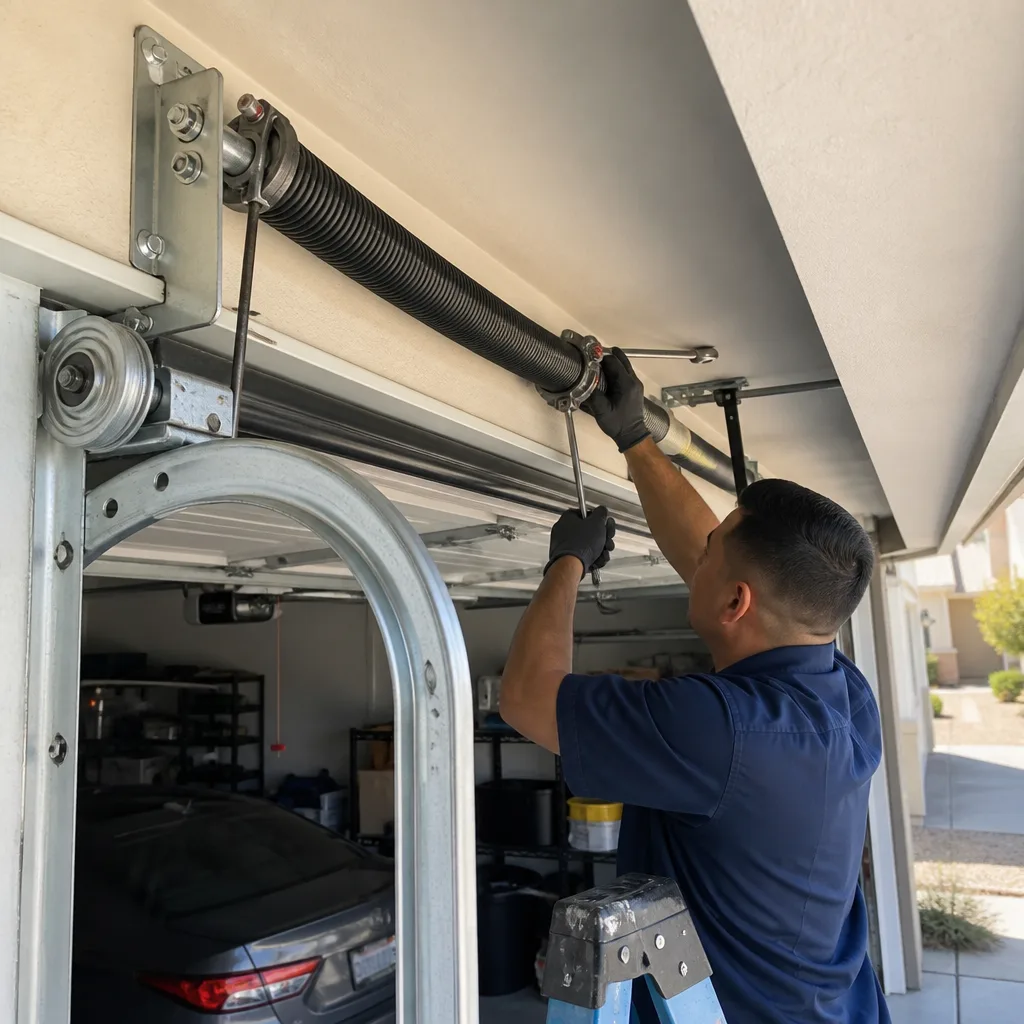
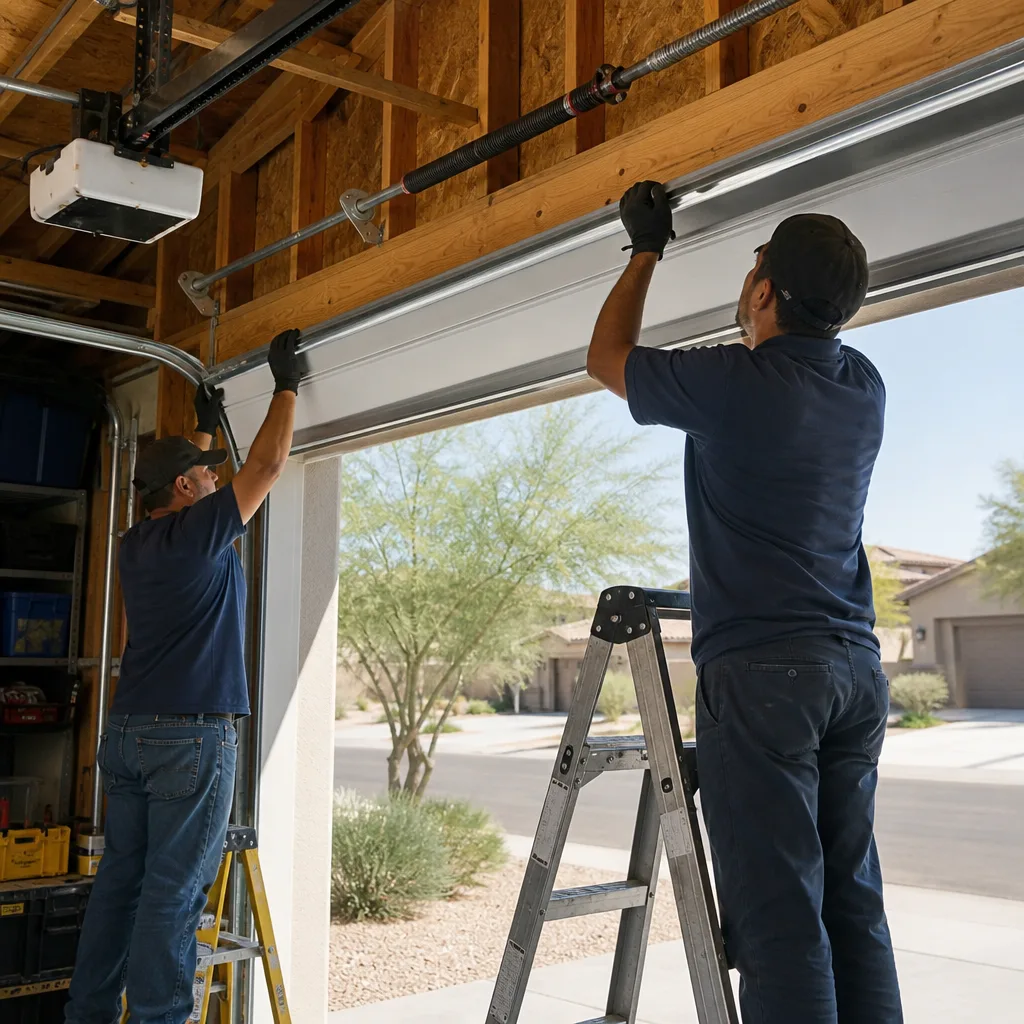
- Look at the spring. A torsion spring is the long coiled spring mounted on the metal shaft above the closed door. Look at the coil spacing. A spring under even tension has even gaps between the coils along its length. A spring with a gap in the middle, where the coils are separated and the two halves look pushed apart, has broken. That’s the clean break we mentioned in the opening, and it’s visible from the garage floor without getting closer than six feet to the spring.
- Look at the track. The vertical tracks on each side of the door and the horizontal tracks that run back into the garage should be straight and parallel. A track that bows outward at a bracket, or a bracket that’s pulled away from the wall, is visible and worth noting.
- Listen, once. Close the door one time and listen. You’re listening for a new sound, not a diagnostic-grade analysis. Grinding, popping, rattling, all of it is information.
We recommend taking photos during this inspection, not just because it helps you remember what you saw, but because the photo record is useful when you describe the problem to a technician over the phone. The photo angles that matter are covered in the section below.
Two Warning Signs That Mean Stop Using the Door Now
Most warning signs allow the door to keep operating for a few weeks while you schedule a non-emergency appointment. Two signs do not. If you see either of these, close the door, lock it if you can, use the pedestrian door instead, and call a professional. Do not operate the door again until someone has looked at it.
Sign one: visible cable slack. The lift cables are under the same tension as the springs they’re connected to. When a cable goes slack, it means the tension is no longer evenly distributed between the two sides of the door. The next cycle could see the cable snap entirely, or the door come off its track, or the spring release its energy in an uncontrolled way. All three outcomes are dangerous. We’ve seen doors in Surprise neighborhoods, from Marley Park to Sierra Montana, come off their tracks because a cable went slack and the homeowner kept using the door for a week while waiting for payday. The repair after the door comes off the track is always more expensive than the repair before it does.
Sign two: a door that reverses downward unexpectedly. The auto-reverse is a safety feature that pushes the door back up if it hits something. When the door does the opposite, starts closing and then suddenly drops or reverses direction without a full cycle, something in the balance or the force settings is wrong. A door that drops is uncontrolled. An uncontrolled door weighs 150 to 300 pounds depending on the model, and it can cause serious injury. This is the one warning sign where we’ll say it plainly: do not use the door until a professional has diagnosed it.
Both of these are emergency situations. Our Servo Garage Doors Surprise home service line is answered by a live person 24 hours a day, seven days a week, including holidays and monsoon nights, at (928) 588-1812. We send a technician, not a callback promise.
How to Photograph and Describe a Warning Sign for an Accurate Preliminary Quote
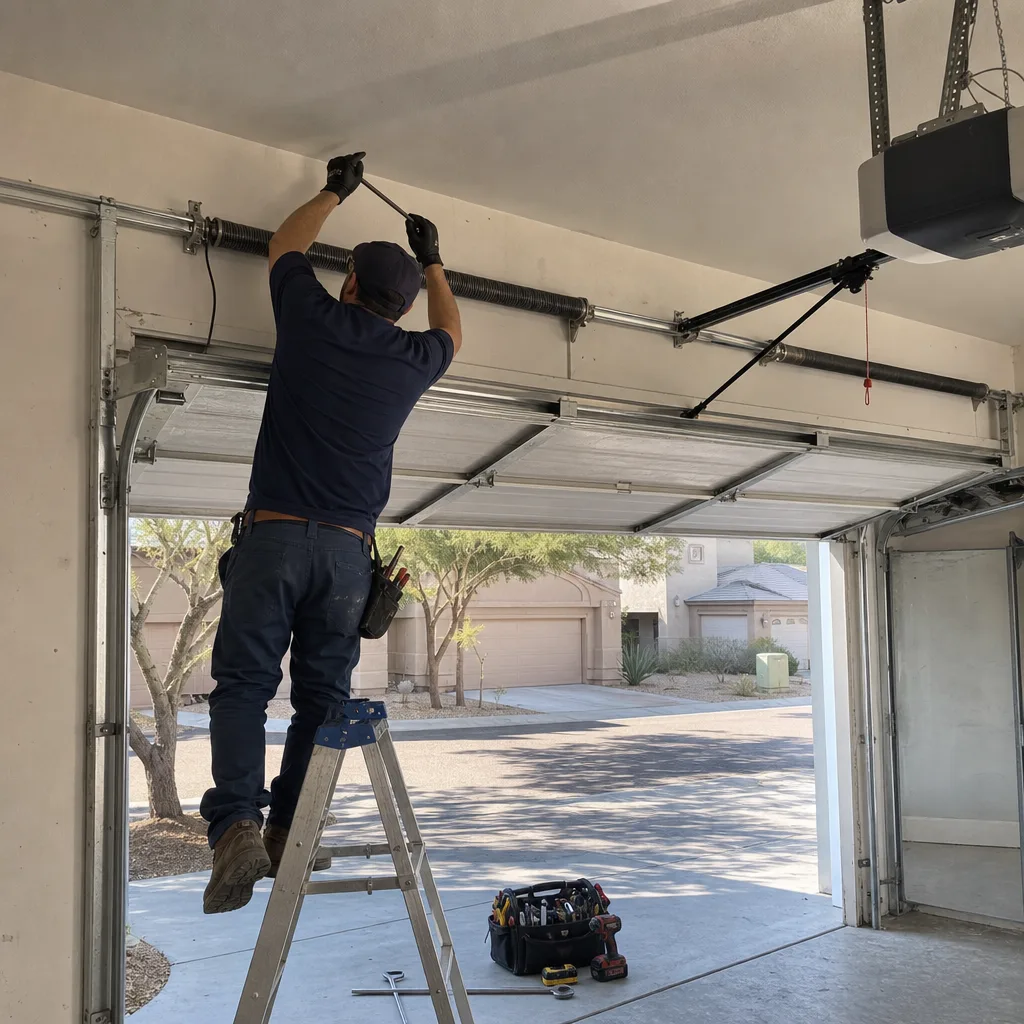
The founding rule of Servo Garage Doors, the one that became Clause 4 of The Haven Standard, is that the customer sees the failed part before anyone quotes a replacement. That rule works because we photograph what we find. It also works for you: if you photograph what you’re seeing before you call, we can often give you a preliminary range quote before a technician arrives. A preliminary range is not a final quote, and we won’t pretend it is. But a $60 diagnosis visit is a waste of everyone’s time if we can tell from two photos that you’re likely looking at a $240 roller replacement or a $180-$340 spring repair.
Three photo angles capture what matters:
- The spring from six feet away, straight on. Stand in the center of the garage, face the spring, and take a photo that shows the full length of the torsion spring. This photo shows the coil spacing, which tells us whether the spring has broken and where. Do not get closer than six feet. The photo does not need to be closer.
- The cable and drum from the side. Stand to either side of the door and photograph the cable where it winds onto the drum at the top corner. This photo shows whether the cable is frayed, whether it’s seated correctly on the drum, and whether there’s visible slack.
- The bottom edge with the door closed. A photo of the bottom seal from inside the garage, showing the gap or the condition of the seal. This tells us whether you’re looking at a seal replacement or a travel limit adjustment.
When you call, describe the symptom in one sentence, then name the component you suspect. “The door is slow, and I think it’s the rollers because I can see one that’s chipped” is a better conversation than “the door is slow.” The former tells us you’ve looked, and we can talk about the likely cost range with more confidence. The latter means the technician will need to diagnose on site, which is fine, but it adds a step before you know what you’re looking at.
Every visit from Servo Garage Doors Surprise includes a documented photo record, meaning you receive photos of what we found and what we did. We do not ask you to trust our diagnosis; we show you the part.
Warning Signs That Are Installer Error, Not Component Wear
Not every warning sign means a part is failing. Some signs are present from the day of installation or appear shortly after, and they point to something different: the original installer got something wrong. These are among the most common things we find in Surprise homes, especially in communities built between 2015 and 2025 where the builder subcontracted the door installation and the homeowner never met the installer.
- Misaligned tracks from improper bracket placement. A track that’s visibly bowed between brackets, or that aligns at the top but drifts at the bottom, was usually installed with brackets at the wrong spacing. The tracks are not warped; the initial bracket placement was wrong. The fix is re-aligning and re-securing the brackets, and it’s a repair that should not require new track sections unless the misalignment has caused metal-on-metal wear.
- A gap at the bottom that was present from day one. If the door has never sealed evenly against the floor, the likely explanation is that the installer set the travel limit slightly too high, or the floor slab has a high spot the installer never compensated for. The fix is a travel limit adjustment, or in slab-related cases, a thicker bottom seal or a threshold strip.
- Auto-reverse sensitivity set wrong at installation. A door that reverses when it shouldn’t, or occasionally doesn’t reverse when it should, often has a force setting that was never properly calibrated. The opener was installed, cycled a few times, and left with whatever factory settings it shipped with. A proper force calibration is a 20-minute adjustment.
- A door that’s loud from the start. A newly installed door that grinds or squeals from week one is usually running on rollers that were not lubricated at installation, or on hinges that were over-tightened. It’s not component wear; it’s an incomplete job.
These are the cases where our Free Second Opinion offer matters most. If another company has given you a written estimate for a replacement door, and we can show that the problem is installer error fixable with an adjustment instead of a new door, bring the paperwork. We’ll look at it and give you our written assessment. No coupon, no code, no fee.
Why the Surprise Climate Accelerates Certain Warning Signs
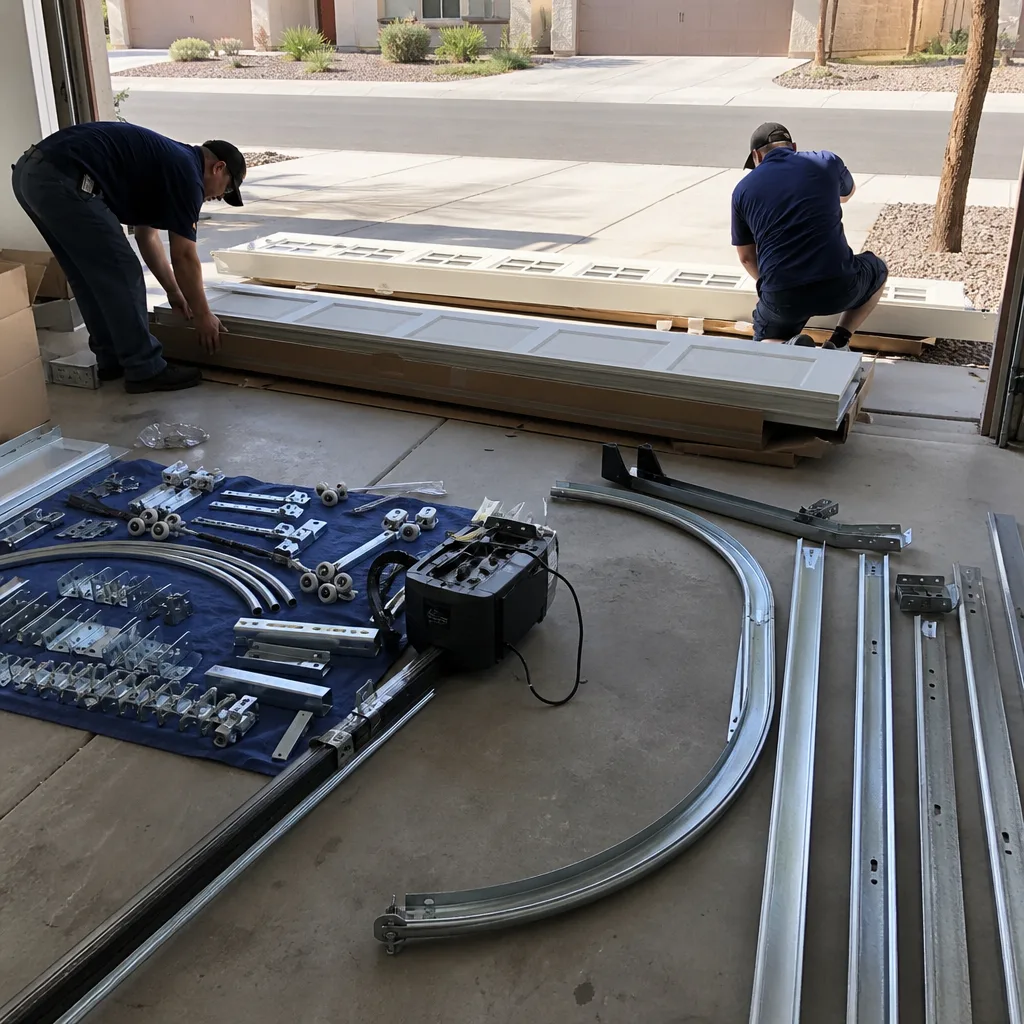
Surprise is a desert city, and the climate does specific things to garage door components. We see these patterns in every neighborhood we serve, from the newer builds in Asante to the established streets around Surprise Farms and Mountain Vista Ranch.
The heat is the primary accelerant. A torsion spring rated for 10,000 cycles, the industry-standard rating for a residential door that opens and closes about four times a day, will not last 25 years in Surprise. The average spring we replace here is between 7 and 12 years old. The daytime heat, especially in the garage where temperatures can exceed 120 degrees in July and August, fatigues the spring steel over time. The result is a spring that loses tension gradually, then breaks, usually at the coldest point of the coil, in the middle. A spring that loses tension gradually produces a slow door. A spring that breaks produces a door that won’t open at all.
The seals and rollers also degrade faster here. Vinyl and rubber bottom seals harden and crack in sustained heat, which is why we see more gap-at-the-bottom complaints from Surprise homeowners than from homeowners in cooler parts of the Valley. Roller bearings lose lubricant faster in dry, dusty air, which shortens their lifespan and produces the grinding and jerky movement symptoms earlier in the door’s life.
Monsoon season adds a secondary variable. The dust and wind that precede a monsoon storm push fine particles into the track, the rollers, and the opener mechanism. A door that operates fine for 11 months and then starts grinding in July may simply need a cleaning and lubrication. A door that grinds year-round is past cleaning.
The brands we service most in Surprise, Amarr, Wayne Dalton, and Raynor, all build doors rated for desert use, but the rating is for the door panels, not the springs, rollers, and seals. Those are consumable components, and the climate consumes them faster here than it does in Flagstaff or Prescott.
What Warning Sign Repairs Typically Cost in Surprise
We quote flat, written prices before any work starts. That’s Clause 1 of The Haven Standard, and it applies to every job, no exceptions. The ranges below reflect what we’ve actually charged Surprise homeowners for these repairs in the last year. They are not a menu, and your specific repair may fall outside them, but they’re an honest starting point for knowing what you’re looking at before you call.
- Roller replacement (set of 10 to 12 rollers): $180 to $320, depending on nylon vs. steel-bearing rollers and the number of panels.
- Torsion spring replacement (single spring, standard residential): $220 to $340, with spring rating and door weight as the variables.
- Cable replacement (both cables, includes re-tensioning): $200 to $310.
- Bottom seal replacement: $120 to $180, depending on door width and seal type.
- Travel limit and force adjustment: $90 to $150, often included with a full diagnostic visit.
- Logic board or receiver replacement: $150 to $280, depending on opener brand and board availability.
- LED bulb replacement with garage-door-rated bulb: $10 to $35, done on the spot.
The price you’re quoted is the price you pay. If the technician finds something additional once the door is open, the scope changes, and you see the written change before any additional work happens. That’s the paper trail every Servo job closes with, and it’s why we don’t do verbal estimates or call-for-a-quote pricing.
For a deeper look at repair costs, our Garage Door Repair in Surprise page has more detail. For installation pricing on new doors, see Garage Door Installation in Surprise. And if your warning sign involves the opener rather than the door itself, our Garage Door Opener Repair & Installation in Surprise page covers the opener-specific symptoms and costs.
Common Mistakes to Avoid
- Using the door anyway because it still opens. A door with cable slack or a broken spring will continue to operate until it doesn’t. The failure, when it comes, is more expensive and more dangerous than the repair would have been a week earlier. If you see cable slack, stop using the door.
- Oiling the spring yourself. A torsion spring under tension does not need to be oiled, and reaching up to oil it puts your face and hands near a component that can release energy suddenly. Do not do this.
- Assuming the remote battery is the problem. Remote range loss is usually LED interference, not a dead battery. Changing the battery and finding the range still degraded delays the actual fix. Check the bulbs before you change the battery.
- Calling a company that quotes over the phone without seeing the door. A business that gives a firm quote without seeing the door is guessing, and a guess is not a quote. A good company gives a preliminary range and confirms the written price on site, before work starts. That’s the Servo model, and it’s the model we recommend you insist on from anyone.
- Replacing the opener when the spring is the problem. A door that’s slow or heavy often gets diagnosed as a failing opener when the actual problem is a spring that’s lost tension. Replacing the opener does not fix the spring, and the new opener will now fight the same fighting spring until it too wears out. Ask whoever diagnoses your door to show you the component they’re proposing to replace. If they won’t show you the failed part, get a second opinion.
- Skipping the photo record. If you don’t have photos of the failed component, you can’t evaluate the diagnosis. A technician who points at a spring and says “it’s shot” without showing you the break is asking you to trust them. Our standard is to show you the photo. You should expect that from anyone you hire.
- Waiting through monsoon season to fix a gap at the bottom. The gap doesn’t fix itself, and during monsoon season it becomes an entry point for water, dust, and rodents. Surprise gets its share of heavy monsoon downpours, and a half-inch gap at the slab is enough for water to pool inside the garage. Fix it before the storms, not after the damage.
When to Call a Professional
Call a professional if you see cable slack, a broken spring, a door that drops or reverses downward, or any condition that makes you hesitant to operate the door. Call if the visual inspection turned up something you can’t identify. Call if you’ve already had one company give you a diagnosis and you want a second opinion with documentation. Servo Garage Doors Surprise offers free estimates in Surprise, and every visit closes with a documented photo record of findings and completed work. Call (928) 588-1812, any hour, and a live person will answer.
Frequently Asked Questions
A door that won’t open is most often a broken torsion spring or a failed opener. Spring replacement in Surprise typically runs $220 to $340, depending on the spring rating and door weight. An opener replacement runs $350 to $600 installed, depending on the opener model. Call (928) 588-1812 for a precise written quote before any work starts.
Yes. We maintain availability for same-day service in Surprise, and emergency calls are answered by a live person 24/7, not a recording. Tell us the symptom when you call, and we’ll give you a preliminary range quote and send a technician.
The written price you receive before work starts is the price you pay. If the technician finds something additional that changes the scope, you see the written change and approve it before any additional work happens. That’s Clause 1 of The Haven Standard, and we don’t vary from it.
Yes. Our trucks carry rollers, cables, springs, bottom seals, hinges, and the opener parts we most commonly replace. Most repairs are completed on the first visit.
A spring that’s losing tension produces a door that’s slow or heavy to lift manually. A broken spring produces a door that won’t open at all, or opens a small amount and stops. Both are visible: reduced tension shows as uneven coil spacing, a break shows as a clean gap in the middle of the spring. Both should be addressed before using the door again.
Yes. Every Garage Door Installation in Surprise includes removal and disposal of the existing door, plus new tracks, new hardware, and new weatherstripping. The written quote includes every line item, so there’s no surprise removal fee added later.
The Bottom Line
The warning signs your garage door gives you are specific instructions if you know how to read them. A slow door is a spring, a motor gear, or a roller. A jerky door is a roller or a track. A loud door is a bearing, a hinge, or a loose bolt. A gap is a seal or a limit switch. A door that reverses is a sensor or a force setting. Visible cable slack is a stop-now condition. In Surprise’s heat, these components wear faster than the national average, so check them once a season, photograph what you find, and call with the component name in hand. We’ve built our business on showing you the failed part before we quote a replacement, and we’ll show you the same respect on your first call. Call Servo Garage Doors Surprise at (928) 588-1812 for a free estimate, and we’ll help you name the part before we touch anything.
Written by Marcus Deller, Owner at Servo Garage Doors Surprise, serving Surprise since 2015.